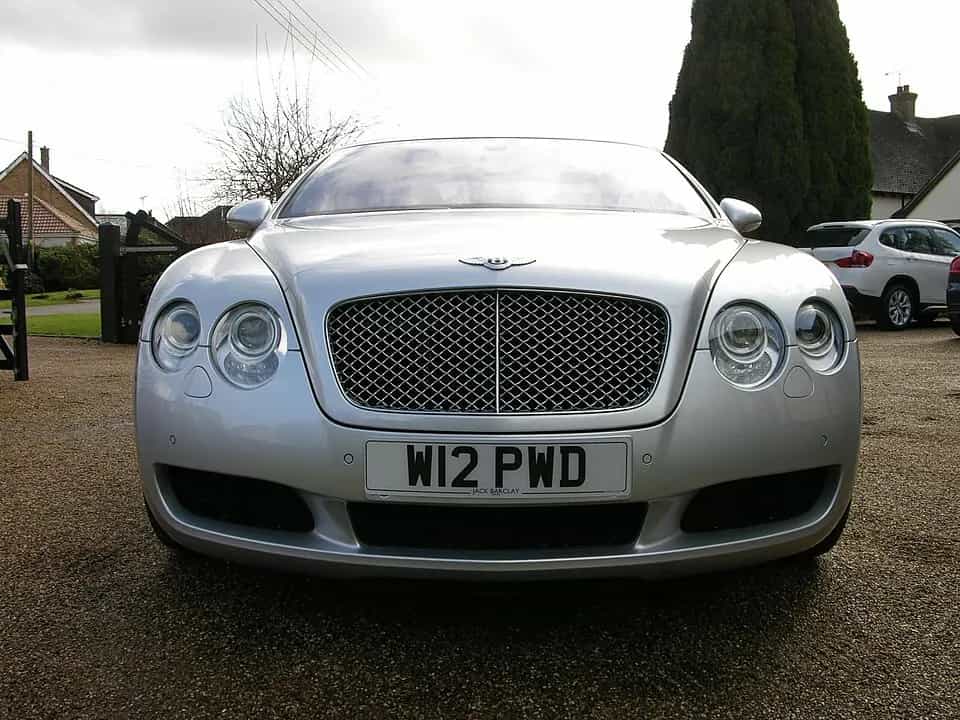
Bentley Continental GT
Importing a used Bentley Continental GT from the USA
The Continental GT is the car that turned Bentley from a low-volume coachbuilder into a genuine luxury-performance marque, and the United States has always been its single largest market. That matters if you want to buy one: the American classifieds carry more Continental GTs, in more colours and specifications, than almost anywhere in Europe, and depreciation on these grand tourers is famously steep. As an independent broker for used US vehicles, USCar Trader helps German and EU buyers source a Continental GT from the USA, verify its history, and bring it home cleanly. This is a car that rewards patient sourcing and a hard look at maintenance records more than almost any other model we handle.

Model history and generations
The first-generation Continental GT (2003-2011) launched the modern Bentley era on Volkswagen Group underpinnings, defined by its 6.0-litre twin-turbo W12. The second generation (2011-2018) sharpened the styling, added a 4.0-litre twin-turbo V8 from 2012, and switched to a smoother eight-speed automatic. The third generation (2018-2024) moved to the MSB platform shared with the Porsche Panamera, gained a dual-clutch transmission, 48-volt active anti-roll, and a rotating dashboard display. When you import a used Continental GT from the USA you will mostly be choosing between second- and third-generation cars, with early first-gen examples now firmly in enthusiast territory.
Engines and drivetrain
Two engine families dominate. The 6.0-litre W12 twin-turbo produced roughly 552 to 626 hp depending on year and Speed variant, delivering effortless, seamless thrust and the model's signature character. The 4.0-litre V8 twin-turbo (an Audi-derived unit) offered around 500 to 550 hp, a livelier note, noticeably lower running costs and, crucially for import buyers, better fuel figures. Early cars used a ZF six-speed auto; the second generation adopted an eight-speed; the third generation runs a ZF eight-speed dual-clutch. All Continental GTs are all-wheel drive, with the latest cars biased more to the rear for a sportier feel.
Which trim makes sense
The Continental GT is the two-door coupe; its convertible sibling is sold as the Continental GTC. Within the coupe range you will find the standard GT, the more focused GT Speed, and W12 or V8 / V8 S badges. US cars are typically very well equipped — Mulliner packages, ventilated and massaging seats, Naim audio, carbon-ceramic brakes and 21-inch wheels appear regularly. Colour and hide combinations are far more varied in the American market than in most European used stock.
Supply on the US market
Supply is strong across California, Florida, Texas and the New York area. First owners tend to cover low annual mileage, so it is realistic to find a five- to eight-year-old car with modest kilometres and a full dealer history. That said, condition varies enormously: some cars have been meticulously maintained, others neglected once the warranty lapsed and deferred maintenance became expensive. Sun-belt cars can show interior UV damage; look closely at leather, veneer and convertible-style trim even on coupes. A documented service record is worth far more here than a low odometer reading alone.
Who benefits from importing
A US-sourced Continental GT suits the buyer who wants a genuinely fast, comfortable grand tourer and understands luxury-car running costs. If you are comparing a well-kept American W12 or V8 against thin European supply, the import route can open up specification and condition you simply cannot find locally. It is not a car to buy on price alone — budget for tyres, brakes, air suspension and scheduled service — but for the informed enthusiast it is one of the most rewarding used imports in this class.
Technical data
| Attribute | Details (typical, by generation) |
|---|---|
| Body style | 2-door grand tourer coupe (4 seats) |
| Generations | 1st 2003-2011, 2nd 2011-2018, 3rd 2018-2024 |
| Engine A | 6.0 L twin-turbo W12 petrol |
| Engine B | 4.0 L twin-turbo V8 petrol (from 2012) |
| Power (W12) | approx. 552-626 hp |
| Power (V8) | approx. 500-550 hp |
| Torque | approx. 650-900 Nm depending on engine |
| Transmission | 6-speed auto / 8-speed auto / 8-speed dual-clutch |
| Drivetrain | All-wheel drive |
| 0-100 km/h | approx. 3.6-4.5 s (variant dependent) |
| Top speed | approx. 300-333 km/h |
| Length | approx. 4.80-4.85 m |
| Kerb weight | approx. 2,150-2,350 kg |
| Fuel | Petrol (premium) |
| Seating | 2+2 |
Known weak points and maintenance
Continental GT reliability is acceptable for a hand-built luxury car, but the weak points are predictable and can be costly. On W12 cars, ignition coils and coil packs fail with age, and oil and coolant weeps around the valley of the engine are common. Air suspension is the single biggest recurring expense: compressors and struts wear, and warning messages should never be dismissed as trivial. Front lower control-arm bushings, worn brake rotors (the standard iron discs are huge and expensive; carbon-ceramics more so), and electrical gremlins from the many control modules all appear on higher-mileage cars. The V8's lower thermal and mechanical stress generally makes it the cheaper long-term ownership choice. Whichever engine you choose, a car with continuous, documented servicing is the one to buy.
US and EU spec compared
US-market cars run amber front side markers and different rear lighting, and they do not carry a rear fog lamp as standard — both items are typically addressed for German registration. Instrument units read in mph and the navigation/telematics are configured for North America; map data and, on some model years, connectivity features may need attention. Mechanically the cars are essentially global, which simplifies parts supply through Bentley's European network.
The import process in detail
The process runs in a clear sequence: selection of a suitable car and specification; a VIN and plant-of-origin check together with a Carfax or AutoCheck history report; secure payment through escrow rather than direct transfer; ocean freight in a container from a US port to Bremerhaven or Rotterdam; customs clearance on arrival; TÜV inspection and individual approval (Einzelabnahme) for the lighting and any market-specific items; and finally registration at your local authority. USCar Trader coordinates the sourcing, checks and logistics as your intermediary throughout.
What customs clearance really costs
In short: the 0% duty rate applies only with documented US origin (VIN/plant) – German import VAT of 19% is always due.
Customs treatment depends on where the car was actually built. The Continental GT is assembled in Crewe, England, so it is not a US-origin vehicle. The 0% EU import duty available for genuinely US-built cars — under Regulations (EU) 2026/1455 and 2026/1461, in force since 1 July 2026 for directly transported vehicles until 31 December 2029 — will therefore normally not apply to a Continental GT. Instead the standard passenger-car import duty applies, determined by the vehicle's origin. On top of that, the 19% German import VAT (Einfuhrumsatzsteuer) is always charged on the customs value, without exception. We state duty and VAT separately and add no margin; there is never a guarantee of duty-free import.
TÜV, modifications and registration
Typical changes for German approval are the front and rear lighting (side markers, rear fog lamp, sometimes headlight beam pattern) and confirmation of the odometer reading in kilometres or its correct conversion. The speedometer's mph scale is usually accepted with a km/h reference; the individual approval documents the car for the Zulassungsstelle. Because the Continental GT is a mainstream Bentley model in Europe, a competent workshop handles the conversion routinely.
Check before you buy
Before you commit, verify the following: the full 17-digit VIN and that it matches the title and plates; a clean Carfax/AutoCheck history with no salvage, flood or odometer flags; the air-suspension and warning-light status on a test drive or inspection; a continuous service record with dated invoices; the condition of tyres, brakes and any carbon-ceramic system; the state of leather and veneer for UV and wear; and a clear title in the seller's name ready for export.
Common questions
Should I import a W12 or a V8 Continental GT?
The W12 offers the classic Bentley character and effortless pace; the V8 is lighter over the nose, more economical and generally cheaper to maintain. For a used import with an eye on running costs, many buyers prefer the V8.
Is the Continental GT reliable enough to import from the USA?
It can be a dependable grand tourer if you buy one with documented servicing. The known weak points — air suspension, coils, brakes — are manageable when maintenance has been kept up.
Does a US Continental GT qualify for 0% EU import duty?
No. It is built in England, not the USA, so the US-origin 0% rate does not apply. Standard duty plus the 19% German import VAT applies.
What mileage is acceptable on an imported Continental GT?
Service history matters more than the odometer. A higher-mileage car with full records is often safer than a low-mileage car with gaps.
How is the car transported from the USA?
Usually by container ship from a US port to Bremerhaven or Rotterdam, which protects the paint and interior during the crossing.
What needs changing for German registration?
Mainly lighting — side markers and a rear fog lamp — plus the individual approval (Einzelabnahme) and registration formalities.
Can I choose a specific colour and specification?
Yes. The American market offers a much wider range of hide, veneer and equipment combinations than typical European used stock.
Does USCar Trader sell the car to me directly?
No. We act as an independent broker and intermediary for used US vehicles; we source, check and organise the import on your behalf.
Explore more Bentley in the Carhub, compare the open-top Continental GTC and the four-door Flying Spur, or view current Continental GT listings.